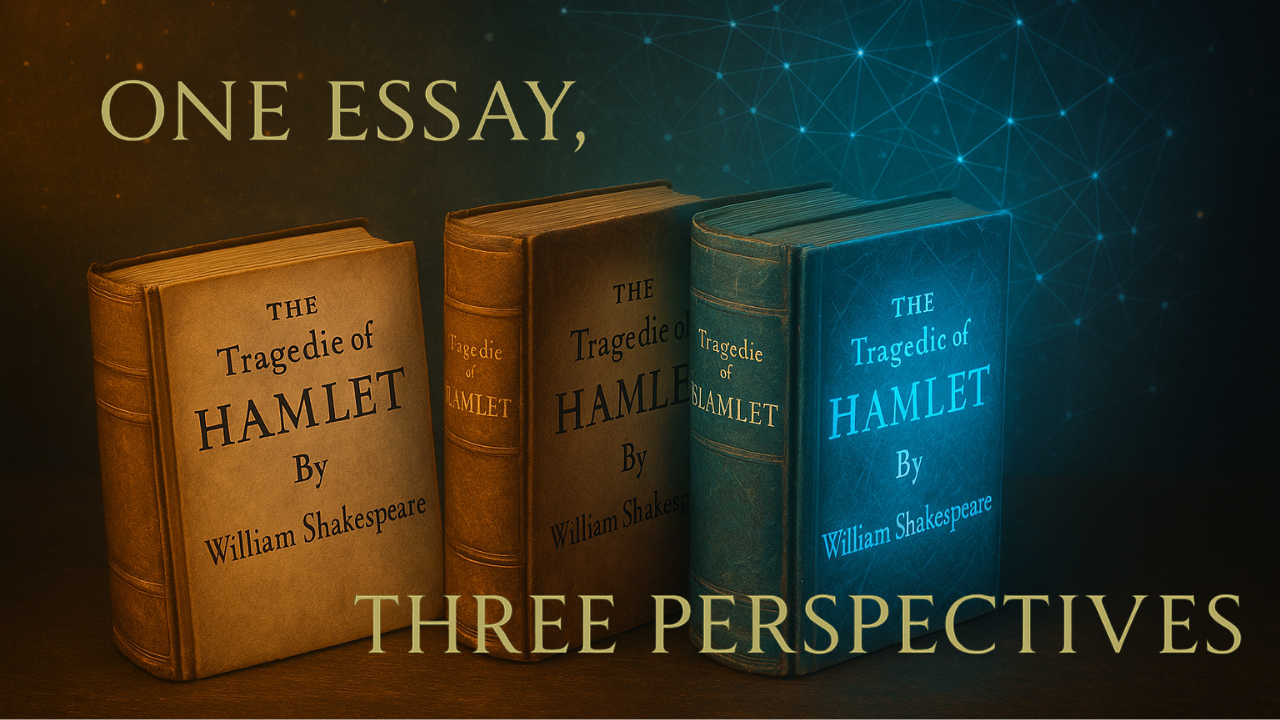
This page is an experiment in “multi-layered writing” with AI.
The same essay is rewritten in three different English styles to see how the tone, focus, and “inner voice” shift with each version.
I’m simply placing three versions side by side here.
Think of it as a small experiment: how different can one idea look, just by changing the voice and style?
- Academic Version
- Intellectual Blog Version
- Popular Essay Version
- Original Japanese Text for This Multi-Layered Experiment
Academic Version
“From Inner Narratives to Externalized Thought:
Hamlet, Shakespeare, and the Emergence of Dialogic Écriture in the Age of AI”
Introduction
One of the most persistent themes in Shakespeare studies is the multi-layered interiority that Hamlet seems to inaugurate in early modern literature. Hamlet’s actions are never reducible to a single motive; his emotional and cognitive states are overdetermined, constantly shifting, and resistant to coherent self-narration. His soliloquies register an attempt to reconstruct a fragmented self through language, and this instability has long been read as the origin of the “modern” subject.
What matters here is not simply Hamlet’s psychology, but the fact that Shakespeare used the theatrical apparatus to stage multiple realities within a single narrative frame. The ghost’s testimony, the play-within-a-play, the public labeling of Hamlet’s “madness”—these are not mere narrative devices but structural mechanisms that reveal interiority as fundamentally plural and unstable.
This essay explores how such early modern strategies of representing interiority resonate—unexpectedly—with contemporary practices of AI-mediated reading. As users engage in dialogue with AI systems, the process of meaning-making shifts from the internal monologue of a solitary reader to an externalized interface where interpretation becomes distributed across human–machine interaction.
1. Hamlet and the Early Modern Multiplicity of the Self
The Stage as a Device for Multiple Realities
Shakespeare’s theater was not simply a mimetic space but a cognitive device capable of sustaining competing layers of reality.
Is the ghost a bearer of truth or a demonic deception?
Does the play-within-the-play reveal guilt or manufacture it?
The unresolved tension between these possibilities produces a form of “layered spectatorship” in which the audience must constantly navigate between incompatible frames of reference. The stage becomes an epistemological experiment—one that mirrors the plurality of the subject itself.
Soliloquy and the Invention of the Oscillating Subject
Hamlet’s soliloquies do not express a unified interiority; they fabricate it.
Each moment of speech reframes his motivations, exposing the impossibility of a stable self-representation.
Rather than revealing a coherent identity, Hamlet’s speeches dramatize the process of becoming legible to oneself—a process that remains perpetually incomplete. In this sense, Shakespeare’s innovation lies less in “psychological depth” than in the formalization of subjective instability.
2. AI Dialogue as a New Mode of Externalized Thought
Beyond Narratives as the Primary Medium of Interiorization
In the contemporary technological environment, human cognitive oscillations no longer require the mediating structure of narrative or drama to become visible.
Dialogues with AI systems externalize the internal, transforming private cognition into a quasi-public process.
Where soliloquy once served as the stage for self-articulation, AI conversation becomes an interface through which thought takes shape in real time.
The Interface as a Site of Difference
AI is not a mirror of the self.
It introduces conceptual differences into the space between prompt and response, thereby generating a new kind of cognitive field:
- a space not confined to subjective interiority
- not reducible to narrative sequence
- but produced at the boundary between user and system
This “interface space” functions as a novel mechanism for multi-layered cognition, echoing the early modern problem of representing a divided self.
3. Convergence of Narrative and AI: Toward a Dialogic Écriture
From Internal Narrativization to Externalization
Narrative traditionally worked as a temporal device for the gradual construction of interiority.
AI, by contrast, produces an instantaneous externalization—a distributed thinking process that does not rely on sustained fictional immersion.
Yet these two processes do not oppose each other.
They constitute parallel routes across the same conceptual terrain:
- one temporal (literary narrativization)
- one spatial/interface-based (AI dialogue)
Both ultimately address the question of how humans encounter and negotiate multiplicity within the self.
Reading with AI as a New Mediating Practice
The emergent practice of AI-assisted reading commentary—a hybrid of annotation, dialogue, and reflective writing—creates a new micro-fictional space outside the text.
The reader’s questions and the AI’s responses form a secondary narrative layer, neither fully inside nor outside the literary work.
This essay positions such reading practices as a nascent form of dialogic écriture:
a mode of writing and thinking generated through the interplay of human curiosity and computational responsiveness.
Conclusion
Just as Shakespeare used the theatrical apparatus to make interior plurality visible, AI systems generate new forms of multiplicity through interactive dialogue.
We are witnessing a shift in the locus of “narrative work”—from the internal monologue of the modern subject to the interfacial dynamics between users and external systems.
This is not the end of narrative but a transformation of its geological layers.
As reading practices evolve through AI interaction, they reveal a new epistemic landscape in which interiority becomes porous, distributed, and co-constructed.
Future explorations of literature and AI dialogue may clarify how these emerging forms reshape our understanding of subjectivity, fiction, and the act of reading itself.
Intellectual Blog Version
“From Inner Worlds to External Dialogue: Hamlet, Shakespeare, and the New Landscape of AI-Assisted Reading”
Introduction
For centuries, readers have turned to Hamlet as the place where something like the “modern self” first flickers into view. Hamlet isn’t driven by one clear motive. He doubts, hesitates, overthinks, reverses himself, and tries—through speech—to assemble a self he can live with.
Shakespeare didn’t simply describe this instability; he built a theatrical machine that made multiple realities appear at once. A ghost that may or may not tell the truth. A play-within-a-play that could expose guilt—or manipulate it. A supposed “madness” that is read differently by every character who encounters it.
In today’s world, where AI dialogue has become a routine part of reading and thinking, we’re seeing a surprisingly similar phenomenon:
not a return to early modern drama, but a shift in how “interiority” becomes visible.
This essay explores that shift.
1. Hamlet and the Birth of the Multi-Layered Self
The Stage as a Cognitive Device
Shakespeare’s stage didn’t just show a story.
It created multiple interpretive frames at once, and the viewer had to navigate among them:
- Is the ghost a messenger or a trickster?
- Does the play reveal truth or generate paranoia?
- Is Hamlet unstable—or performing instability?
The effect is a kind of layered spectatorship, where meaning is never singular. The stage becomes a device for thinking in multiplicities.
Soliloquy as a Prototype for Inner Narration
Hamlet’s soliloquies read like attempts at self-debugging.
They reveal less about “who he really is” and more about how a person tries to become legible to themselves when certainty dissolves.
This is why Hamlet feels familiar to modern readers:
he dramatizes the inner noise we usually hide.
2. AI Dialogue and the Externalization of Thought
From Inner Monologue to Shared Interface
Today, something unusual is happening.
With AI systems becoming part of our reading and thinking process, the private realm of inner monologue starts to spill outward.
Instead of asking ourselves silent questions while reading a text, we ask them to an AI—and the answers return immediately as part of our extended thought process.
It’s not that AI “thinks for us.”
Rather, it creates an interface where our thinking becomes visible in a new way.
AI as a Generator of Difference, Not a Mirror
AI does not simply reflect what we already know.
It introduces new angles, new frames, small dissonances.
Between prompt and response, a difference-space opens:
- not internal like a soliloquy
- not narrative like a play
- but between user and system
This interface becomes a site of externalized cognition—a parallel to the layered interiority that Shakespeare staged.
3. Where Literature and AI Meet: A New “Dialogic Writing”
Narrative Slowness vs. Interface Immediacy
Literature historically worked slowly.
It built interiority over time, through narrative depth.
AI works instantly.
It surfaces alternative interpretations in seconds.
These modes aren’t in conflict.
They simply represent two ways of accessing human multiplicity:
- narrative as a slow construction
- dialogue as rapid externalization
AI-Assisted Reading as a New Mediating Practice
When a reader engages with a text through AI—asking, probing, reflecting—they create a small, improvised fiction outside the book.
A kind of side-channel narrative forms:
- part interpretation
- part conversation
- part exploratory thinking
This hybrid practice suggests a new kind of writing—
a dialogic écriture, where meaning emerges through interaction rather than solitary reflection.
Conclusion
Just as Shakespeare used the stage to reveal the plural structure of the early modern self, our current tools are exposing the plural structure of contemporary thought.
AI dialogue doesn’t replace literature.
It alters the terrain on which reading happens.
We are moving from a model of
“inner narrative” → “external dialogue”,
not by abandoning interiority, but by relocating it to the interface between human and machine.
In this transitional moment, practices like AI-assisted reading or “reading livestreams” may become windows into a new form of narrative consciousness—
one that is collective, interactive, and layered.
The story isn’t ending.
Its geology is shifting.
Popular Essay Version
“Hamlet, AI, and How Our Ways of Thinking Are Changing”
Introduction
For many people, Hamlet is famous for one line:
“To be or not to be.”
But the real magic of the play is how it shows a mind in motion.
Hamlet cannot make quick decisions.
He questions everything—including himself.
And through this, Shakespeare created one of the first stories that lets us watch a person think.
Interestingly, something similar is happening today, but for a very different reason:
AI conversations are changing how we understand our own thoughts.
This essay looks at both—Shakespeare’s world and our own—to see how the idea of “inner life” is shifting.
1. Hamlet and the Birth of the Modern Inner Self
The Stage as a Place with Many Layers
Shakespeare used the stage almost like a psychological tool.
- A ghost appears—but is it real?
- A play is performed—but is it truth or a trick?
- Hamlet acts “mad”—but is it an act or something more?
Everything has more than one meaning.
The audience must look at several possibilities at once.
For the time, this was revolutionary.
Soliloquies: Thinking Out Loud Before It Had a Name
Hamlet often steps aside and talks to himself.
These soliloquies feel like early versions of the “inner voice” we now recognize as part of being human.
Through them, Shakespeare shows us:
- doubt
- fear
- self-argument
- conflicting desires
This was new. Before Shakespeare, characters spoke mainly to advance the plot, not to reveal their private conflicts or emotional complexity.
2. How AI Conversations Change the Way We Think
From Private Thoughts to Shared Dialogue
Today, we often read a book or watch a show with an AI assistant close by.
We ask:
- “What does this line mean?”
- “Why is this character acting this way?”
- “What’s the historical context?”
And the AI answers instantly.
This shifts something important:
Our thought process becomes external.
We no longer work only inside our own heads.
AI Is Not a Mirror—It Adds New Angles
When we ask a question, AI doesn’t just repeat what we already think.
It gives a new angle, a new connection, or a different reading.
Between our question and the answer, a small “thinking space” appears.
This is not inside the book, and not inside our mind—
it’s between human and machine.
3. A New Kind of Reading: Dialogue as Meaning-Making
Stories Build Inner Worlds Slowly; AI Opens Them Quickly
Literature takes time.
It builds emotion and understanding slowly, through narrative.
AI is fast.
It offers interpretations in seconds.
These two modes aren’t enemies.
They simply show two paths toward understanding ourselves:
- one slow and emotional
- one quick and interactive
Both reveal different sides of our thinking.
Reading with AI Becomes a Small “Story Outside the Story”
When we read and ask questions to an AI, a new mini-narrative forms:
- What we notice
- What we wonder
- How the AI responds
- How we react to that response
It’s a tiny story unfolding in real time.
This is a new form of storytelling—
a dialogue-based way of making meaning.
Conclusion
Shakespeare used theater to show how complicated people really are.
Today, AI helps reveal that same complexity in a new way.
We are shifting from
“inner monologue” → “external conversation,”
not because we are losing our inner life,
but because a new space for thought has opened up.
Reading with AI—whether as a study tool, a curiosity, or a “reading livestream” style experience—might be an early sign of a new kind of storytelling:
- interactive
- reflective
- and shared
The story isn’t ending.
It’s changing shape.
Original Japanese Text for This Multi-Layered Experiment
All three versions presented here are derived from a single Japanese essay—
the source text for this small experiment in multi-layered writing.
The original Japanese version is included below for reference.
You can read the original Japanese version here:

コメント